

38 TERMS DEFINED
Coastal NC Dock Glossary
Plain-English definitions for the terms you will see on quotes, permits, and contractor conversations.
38 Terms6 CategoriesPlain English
3
1 term316 Stainless Steel
Hardware
- A grade of stainless steel containing 2–3% molybdenum, giving specific resistance to chloride pitting (the corrosion mode that destroys lesser metals in coastal salt water). Required spec for fasteners on the saltwater side of every coastal NC dock. See related service
A
2 termsAEC (Area of Environmental Concern)
Permits
- A NC Division of Coastal Management designation for waters and shorelines requiring CAMA permit review. Public Trust Waters, Estuarine Waters, and Coastal Wetlands are all AECs.
Aerial Map
Process
- A top-down satellite or drone image used to plan dock layout, verify CAMA setbacks, and document existing site conditions before construction begins.
B
1 termBulkhead
Structures
- A vertical retaining wall built along the shoreline to prevent erosion and create a stable transition between land and water. Often the starting point for dock and pier construction.
C
4 termsCAMA (Coastal Area Management Act)
Permits
- A 1974 NC General Assembly law that regulates construction in the 20 coastal counties of North Carolina. Almost every coastal NC dock, pier, or boat lift requires a CAMA general permit.
CAMA General Permit
Permits
- The standard permit type for residential coastal NC docks, piers, and boat lifts. Covers structures within size and setback limits. Processed in 14–30 days at a fee of $474.
CAMA Major Permit
Permits
- Required for commercial projects, marinas, or any work that does not fit general permit limits. Processed in 75–150 days at $475+.
Cradle Lift
Structures
- A type of boat lift that supports the hull on padded bunks within a galvanized I-beam frame. Most common 4-post lift configuration for boats up to 24,000 lb.
D
2 termsDecking
Materials
- The walking surface of a dock or pier. Common options in coastal NC: pressure-treated southern yellow pine ($3–5/sq ft), marine-grade PT ($5–7), or IPE Brazilian hardwood ($14–22). See related service
Driven to Refusal
Process
- A pile-driving standard where the piling is hammered until it cannot advance more than 1 inch per 10 hammer blows at full energy. This — not a fixed depth — is the only reliable indicator of bearing capacity.
F
4 termsFender Pile
Structures
- A piling installed alongside a dock or boat lift to protect the structure (and the boat) from impact. Usually capped with rubber or foam fender material.
Fixed Pier
Structures
- A non-floating dock structure supported by pilings driven into the bottom. Lifespan 25–35 years in coastal NC. Better than floating in deep water, for roofed structures, or when supporting boat lifts. See related service
Float Drum
Materials
- A sealed, buoyant container — usually HDPE plastic — that provides flotation for a floating dock. USA-made HDPE drums are the industry standard; encapsulated foam is a lower-cost alternative with shorter life.
Floating Dock
Structures
- A dock platform that rises and falls with the tide, attached to vertical pile guides. Ideal for coastal NC waterfronts with 3–4 ft tide swing. Lifespan 15–20 years. See related service
G
2 termsGangway
Structures
- The hinged ramp connecting a fixed pier or bulkhead to a floating dock. Aluminum gangways are most common in coastal NC for weight and corrosion resistance.
Gazebo (Waterfront)
Structures
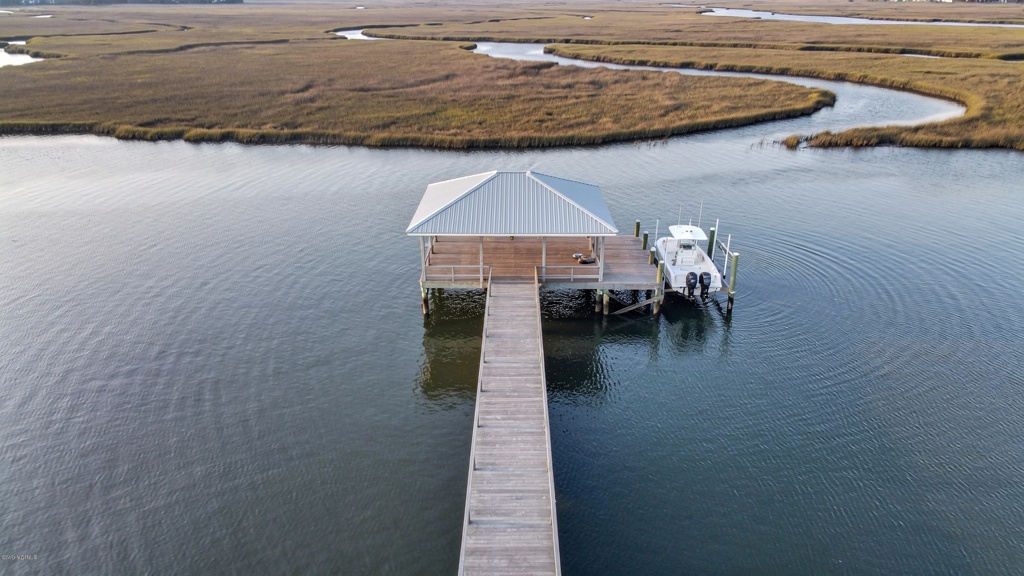
- A covered, often hexagonal or octagonal structure built at the end of a pier or as a stand-alone over-water platform. Coastal NC gazebos must be rated to 130 mph wind in Wind Zone D. See related service
H
2 termsHDPE (High-Density Polyethylene)
Materials
- A thermoplastic used for float drums and some structural components. UV-stabilized HDPE resists saltwater, impact, and degradation better than any common alternative.
Hot-Dipped Galvanized
Hardware
- Steel coated with molten zinc for corrosion resistance. Acceptable for interior framing in coastal NC, but fails in 5–7 years on the saltwater splash side. Not a substitute for 316 stainless.
I
2 termsICW (Intracoastal Waterway)
Coastal Conditions
- A 3,000-mile system of inland waterways from Massachusetts to Texas. The NC section runs the length of our service area, with 3–4 ft tide swings and significant boat traffic.
IPE (Pronounced EE-pay)
Materials
- A dense Brazilian hardwood with a Janka rating of 3,680 lbf — five times harder than southern yellow pine. Lasts 30–50 years in coastal NC with no surface treatment. See related service
J
1 termJanka Hardness
Materials
- A test measuring the force needed to embed a 0.444-inch steel ball halfway into a wood sample. Pressure-treated SYP: 690 lbf. IPE: 3,680 lbf. Cumaru: 3,540 lbf.
L
1 termL-Head Pier
Structures
- A fixed pier with a perpendicular platform extension at the end, forming an L-shape. Provides space for sitting, dining, or a boat slip alongside the platform.
M
2 termsMarine-Grade Lumber
Materials
- Pressure-treated lumber rated for ground contact and water immersion. Higher retention of preservative (typically .60 lb/cu ft) than standard PT. Required for any coastal NC submerged or splash-zone framing.
MHW (Mean High Water)
Coastal Conditions
- The average height of all high tides over a 19-year tidal cycle, used as the reference elevation for CAMA setbacks and dock height requirements.
N
1 termNC GC License
Permits
- North Carolina General Contractor license issued by the NC Licensing Board for General Contractors. Required for any project over $30,000.
P
5 termsPile Driver
Process
- The mechanical equipment used to drive pilings into the substrate. Hydraulic hammers (8,000+ ft-lb energy) are the only type capable of reaching true refusal in coastal NC substrates.
Pile Guide
Structures
- A pair of vertical pilings (with or without rollers) that constrain a floating dock to vertical movement only, allowing the dock to rise and fall with the tide while staying in position.
Piling
Structures
- A vertical structural support driven into the bottom to bear the load of a fixed pier, boat lift, or gazebo. Typically 8×8 or 10×10 pressure-treated pine, driven to refusal. See related service
Pressure-Treated (PT)
Materials
- Lumber impregnated with copper-based preservatives under pressure to resist rot and insects. Standard for coastal NC dock framing. Lifespan 12–25 years depending on retention level and exposure.
PWC Lift
Structures
- A small lift designed for personal watercraft (jet skis). Typically 1,200–1,500 lb capacity. Coastal NC PWC lifts start at $3,500 installed.
R
1 termRefusal
Process
- The point at which a hydraulic pile-driving hammer can no longer advance a piling more than 1 inch per 10 blows at full energy. The only reliable measure of bearing capacity in coastal NC substrates.
S
4 termsSAV (Submerged Aquatic Vegetation)
Coastal Conditions
- Seagrasses and other rooted plants growing under the water surface. CAMA protects SAV — docks must be elevated 3 ft above MHW with 5-ft-on-center decking when crossing SAV beds.
Setback
Permits
- The minimum distance a dock must maintain from a property line projection or other structure. Standard coastal NC CAMA side-yard setback is 15 ft from the adjacent property line projection into the water.
Standing-Seam Metal Roof
Materials
- A roofing system with vertical interlocking seams that resist wind uplift. Standard for coastal NC waterfront gazebos rated to 130 mph wind. 24-gauge or higher recommended.
Stringer
Structures
- The horizontal framing members that span between pilings or floats, supporting the deck boards. Typically 2×8 or 2×10 marine-grade pressure-treated lumber on 16-inch centers.
T
3 termsT-Head Pier
Structures
- A fixed pier with a perpendicular platform at the end, forming a T-shape. Provides maximum platform area for socializing, fishing, or boat docking.
Through-Bolt
Hardware
- A bolt that passes completely through a structural connection (e.g., stringer-to-piling) with a nut on the back side. Stronger than lag bolts. Coastal NC dock standard: 316 stainless 1/2-inch or 5/8-inch.
Tide Swing
Coastal Conditions
- The vertical distance between mean low water and mean high water at a given location. Coastal NC tide swing ranges from 2.5 ft (Wrightsville Beach) to over 4 ft (Hampstead, Sneads Ferry).
FAQ
Questions about coastal NC dock terminology
What does "pilings driven to refusal" mean?
Refusal is the point where a hydraulic pile-driving hammer can no longer advance a piling more than 1 inch per 10 hammer blows at full energy. It is the only reliable measure of bearing capacity in coastal NC substrates — far more meaningful than a fixed depth like "8 feet." Some builders stop at a depth target, which is faster but leaves the dock unsupported when storm surge scours sand from under the piling.
What is the difference between 316 stainless and hot-dipped galvanized hardware?
316 stainless steel contains 2–3% molybdenum, which gives it specific resistance to chloride pitting — the corrosion mode that destroys lesser metals in coastal salt water. Hot-dipped galvanized is zinc-coated carbon steel; it works for interior framing but fails in 5–7 years on the saltwater splash side. Every Intracoastal Installs dock uses 316 stainless on every saltwater-side connection.
Do I need a CAMA permit for a dock in coastal NC?
Yes, almost always. The Coastal Area Management Act regulates construction in 20 coastal NC counties. Residential docks, piers, and boat lifts typically require a CAMA general permit (14–30 days, $474). Commercial projects, marinas, or anything outside general-permit size limits need a CAMA major permit (75–150 days, $475+). We file CAMA general permits in Pender, New Hanover, and Onslow counties in-house.
What is mean high water and why does it matter?
Mean High Water (MHW) is the average height of all high tides over a 19-year tidal cycle. CAMA uses MHW as the reference elevation for dock height requirements, setback measurements, and decking-board spacing rules over submerged aquatic vegetation. If your contractor cannot tell you where MHW falls on your shoreline, they should not be filing your CAMA permit.
How do I use this glossary?
Browse alphabetically using the jump-nav above, or use Cmd/Ctrl+F to search for a specific term. Every definition is plain-English (no marketing language), and terms linked to a service we offer have a "See related service" arrow at the bottom. There are 38 terms total across 6 categories: Materials, Structures, Hardware, Permits, Process, and Coastal Conditions.
Want to talk through these in person?
Free site visit. We translate the jargon as we walk the shoreline with you.