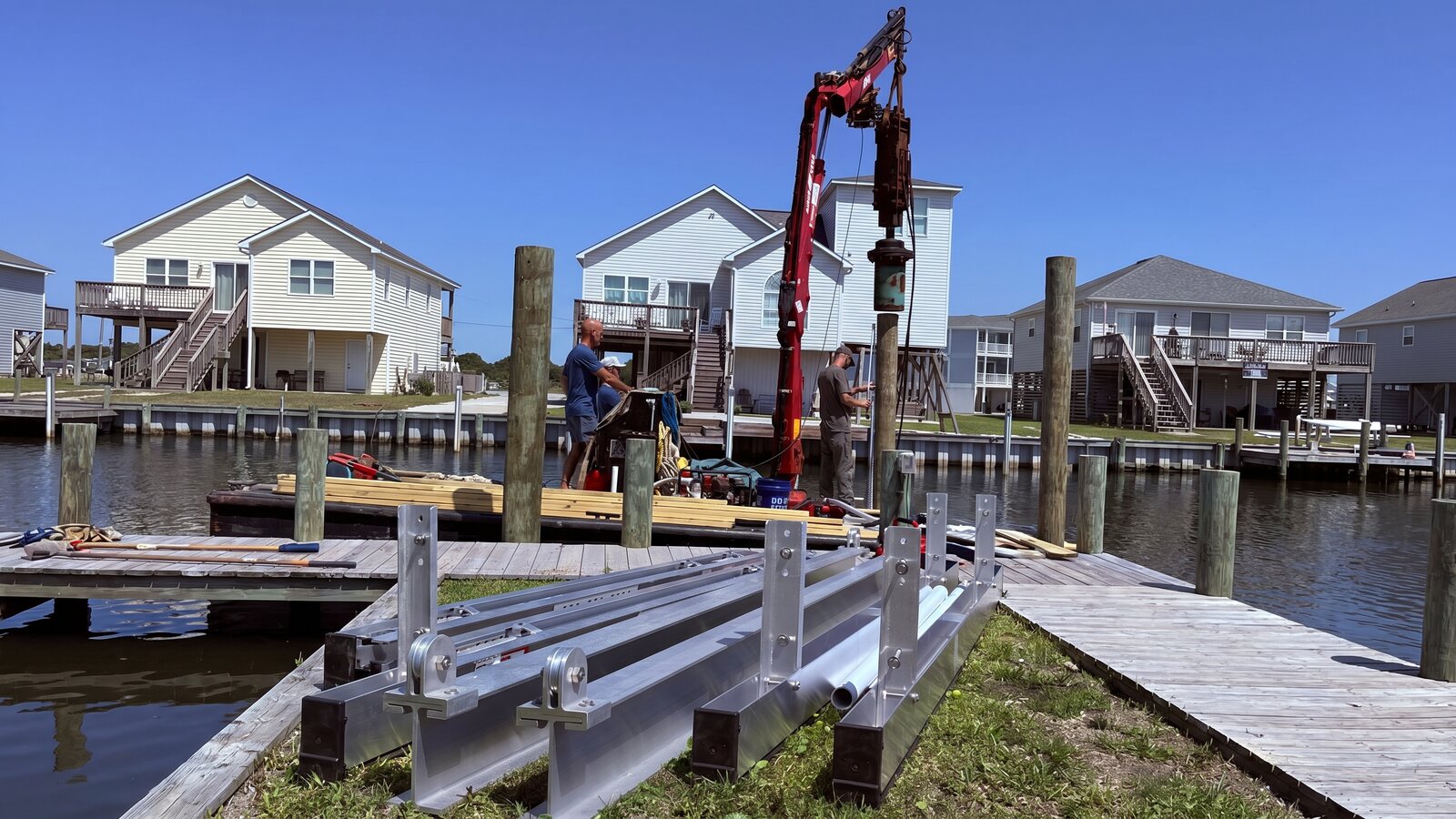

Fixed Piers construction in coastal North Carolina

FIXED PIERS

Fixed Piers That Stand Strong for Decades

Hurricane-rated pier construction for the Cape Fear River, ICW, and Topsail Sound — plus freshwater-lake piers inland, all built on pressure-treated pilings driven to refusal.

Hurricane-RatedPressure-Treated Pilings30+ Years Construction

THE CHALLENGE

Why this matters on coastal NC

A pier that wobbles in a six-knot tide will not survive a Category 1 storm — and a lake pier with shallow pilings shifts every winter. Most pier failures we repair started with the wrong piling depth or undersized hardware, saltwater or fresh.

MATERIALS WE USE

8x8 or 10x10 pressure-treated pilings2x8 marine-grade stringers5/4 deck boards or IPE hardwood316 stainless through-boltsAluminum or stainless cleats

WHAT'S INCLUDED

Every fixed piers build covers

  • CAMA permit-aware piling layout
  • Pressure-treated 8x8 or 10x10 pilings driven to refusal
  • Marine-grade lumber decking, stringers, and railings
  • 316 stainless lag bolts and through-bolts
  • Optional T-head, L-head, or covered roof structure

HOW WE BUILD FIXED PIERS

Our 5-step process

01

Free Site Evaluation

We probe the bottom, check water depth, and confirm the pier length your shoreline allows.

02

Permit-Aware Design

We draw the layout for your CAMA general permit and county sign-off.

03

Pile Driving

We barge in the pile driver and set every piling to refusal so the pier stays put in a storm.

04

Frame & Deck

Stringers, decking, and railing go on with stainless fasteners, square and level.

05

Walkthrough & Cleanup

We test every railing, sweep the deck, and leave a copy of the as-built sketch for your records.

PRICING & TIMELINE

Free Site Evaluation

Free site evaluation. Most residential fixed piers fall in the $18,000 – $60,000 range depending on length and head shape, plus permits.

Request estimate

WARRANTY

One-Year Workmanship

One-year workmanship warranty. Pilings carry their treatment warranty.

Materials carry their respective manufacturer warranties.

VERIFIED GOOGLE REVIEWS

What homeowners say

Real, published reviews from our Google Business Profile — 22 five-star reviews and counting.

5 reviews
·
Mark and his crew did a fantastic job on a complex project involving multiple piers and gazebos. Great craftsmanship. Stayed on the job till it was completed. Highly recommend them for your pier, dock, or bulkhead projects.
Verified Google review
2 reviews · 13 photos
·
Worked with Mark on a set of docks off of Wrightsville intracoastal. They are very great to work with and do awesome work that looks great and lasts long! Highly recommend using them for any dock or coast side needs!
Verified Google review
7 reviews
·
VERY, VERY happy customer! If there were ten stars to grade them, I would rate their product a 10! Superb workmanship on a complicated custom dock. Excellent customer service and responsiveness. Ethical business that exceeded every expectation.
Verified Google review

OUR APPROACH

The Refusal-Driven Piling Standard

Every piling we set goes to refusal — the point where the hydraulic driver cannot advance it further. We do not stop at a number on a clipboard. This standard is why a pier built to refusal stays put when the surge comes and a short-driven one does not.

— Mark Lipe

FROM THE FOUNDER

Fixed Piers done right is invisible — it just works through the next storm and the next ten tides. That's the standard.

— Mark Lipe

FAQ

Questions about fixed piers

How deep do you drive pilings?

We drive every piling to refusal — usually 12 to 20 feet depending on the bottom. We do not stop short to save time.

Will my pier survive a hurricane?

No builder can promise a pier will survive every storm, and you should be wary of one who does. What we can promise is the engineering standard: every piling driven to refusal, 316 stainless hardware on every saltwater connection, and roof framing sized for the local wind zone. Those three things are what separate the piers that ride out a hurricane from the ones that do not.

Do you build covered piers?

Yes, we frame metal-roof covered T-heads and gazebo-style ends. We size the roof for the local wind zone.

Do you build fixed piers on lakes?

Yes. Lake piers usually skip CAMA entirely and we can spec hot-dipped galvanized hardware inboard. The refusal-driven piling standard still applies — softer lake-bottom sediment means we sometimes drive deeper than on a sound-side build.

Talk to us about fixed piers

Free site evaluation. Written estimate within one business day. Every board, fastener, and piling listed.